
BY RIVER FLEISCHNER
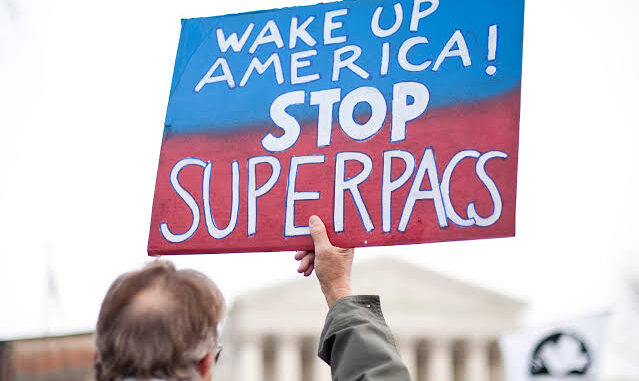
Ten individuals donated about $481 million to Trump’s 2024 campaign, accounting for 44% of all money raised, according to a lawyer for the Brennan Center. The revelation came during a meeting hosted by NY State Senator Liz Krueger to discuss the impact of big money on politics on September 29. Marina Pino, an attorney with the Brennan Center for Justice, a non-profit law and policy institute, joined Krueger to discuss methods to limit the influence of corporate special interest super PACs.
Speaking on Zoom, Pino explained the ubiquity of superPACs and dark money in politics, highlighted the importance of campaign fund transparency, and offered some viable alternatives. “We’ve seen superPACs work in tandem with candidates and parties,” she said, “to the point where affiliate superPAC are now integral to most major campaigns.”
Krueger expressed concern, and wondered aloud if big money was subverting Americans’ ability to hold their elected officials accountable. “That’s how our democracy is supposed to work,” she said.
Although the Federal Election Committee’s role is to monitor campaigns, Pino explained that a combination of Supreme Court decisions and government corruption have weakened its ability to do so.
A superPAC is a political committee formed to solicit and spend unlimited sums of money, according to Ballotpedia, a digital encyclopedia of American politics. Unlike PACs(political action committees), super PACs aren’t officially categorized as political committees, so the same limits do not apply.
In 2010, the Supreme Court struck down prohibitions on corporate spending in a case known as Citizens United, opening the flood gates for corporate money to flow unchecked into American politics, explained Pino.
She went on to explain how this decision created an ecosystem where corporations can bankroll the campaigns for causes and candidates they believe will further their interests, while undermining the decision-making power of voters. “Americans believe that the interests of billionaires and other wealthy interests are prioritized over those of the general public,” said Pino.
Polling from the Brennan Center supports this: the center found that 62% of Americans feel that corruption in politics is a “very big problem.”
While superPACs have been influential in past elections, Pino said the 2024 presidential election was unique in that both campaigns relied primarily on superPAC mega-donors for core campaign activities. Roughly 44% of all money raised to support Trump, about $481 million, came from ten individual donors, according to findings published by the Visual Capitalist, an online data analyst tracker.
Kamala Harris received about $126 million from the top ten donors to her campaign, about eight percent.
Pino described how this system of campaign funding can place outsized influence into the hands of individual billionaires.
In the run up to the 2024 Presidential election, Elon Musk alone donated $240 million to super PACs for the Trump campaign. These groups funded direct mailings and canvassing, and hired spokesperson consultants in swing states. “He essentially became part of the Trump campaign,” said Pino, pointing out that Musk frequently appeared on stage and at rallies alongside Trump.
Shortly after taking office, Trump appointed Musk head of the newly formed Department of Government Efficiency, tasked with targeting excessive government spending.
In the current Texas Senate race, a single oil businessman contributed $750,000 to state attorney general Ken Paxton through the superPAC Lone Star Liberty, which funneled six million dollars to the Paxton campaign.
Earlier this month, Politico reported that Lone Star Liberty was planning a $15 million ad campaign to support Paxton, whose platform includes limiting abortion access (even in the case of life threatening complications) in his race for US Senate against Democrat James Talarico.
Watchdog groups such as the Brennan Center are also concerned with dark money, or funding for candidates and causes whose origins are difficult to discern, and often intentionally obscured.
501(c)4 non-profit organizations are exempt from disclosing the identities of their donors, as long as they don’t claim politics as a primary focus. By applying for non-profit status, superPACs can funnel high volumes of capital into campaigns of their choosing, while retaining the anonymity of their investors. This loophole, enabled by Citizens United, has “undeniably had a negative impact on campaign politics,” wrote Noelle Shih for the Columbia Undergraduate Law Review. Voters are the ones who suffer, she wrote, “as they are unable to access the information needed to make an informed choice.”
In the weeks leading up to the 2020 presidential election, The Future Forward PAC, the largest Democrat superPAC, spent $108 million on ads for the Biden campaign. $74 million of that fund came from un-disclosed donors.
Pino pointed to donation match fund programs as a way to minimize corporate influence on elections. Match fund programs work by matching small contributions from individuals with a larger amount provided by a state fund. In NYC, candidates running for public office can apply to the program to have donations by their supporters matched at a one to eight ratio by city funds. “If you give ten dollars to a local candidate running for a city council seat, they receive $90,” explained NYCVOTES, an initiative of the New York City Campaign Finance Board. According to the NYCVOTES website, 94% of candidates in the 2021 primary participated in the program.