
BY EMILY NIXON
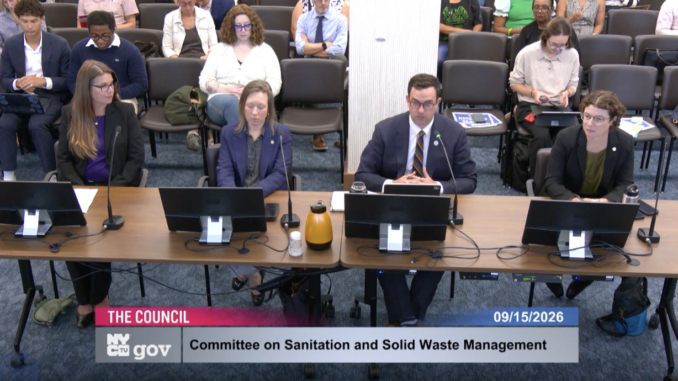
The NY Department of Sanitation [DSNY] told the City Council on Sept. 15 that it will reexamine methods to recycle residential textiles, even though previous pilot programs failed.
“There was a growing realization that we are asking more of our planet and its people than we can endure, and that this economic model, “Take, Make, Waste,” was unsustainable,” said DSNY Commissioner Gregory Anderson.
Textiles, such as clothing or woven fiber items, make up roughly “5% of NYC’s waste stream”, despite a “robust industry” surrounding textile reuse or second hand stores, according to Anderson.
Every year, New York State residents and businesses throw away almost 1.4 billion pounds of textiles that could be reused or recycled, according to the NY Department of Environmental Conservation. Textiles include clothing, footwear, belts, hats, handbags, drapes, towels, sheets and other linens.
DSNY is currently seeking to help outside companies boost their efficiency in processing the items, rather than creating a mandate and method themselves.
“For textiles, there are a number of not-for-profit and for-profit entities developing their own operational capacity for sorting and processing, and DSNY is ready to assist as this industry develops,” said Anderson. “[DSNY’s] current textile recycling partnership provides easy and convenient drop-offs for many New Yorkers, but we are interested in working with private sector partners to develop mass market solutions more aligned with our composting and traditional recycling programs.”
Introduction 256, a bill being heard by the City Council, would require Anderson and DSNY to “study the feasibility and potential environmental effects of a recycling mandate for household textiles,” according to the bill.
While DSNY supports the intent of the bill, Anderson reiterated that there are currently, “several programs to divert [textiles] from landfills” in place.
One such program places a bin to collect residential textiles in various buildings, such as one that has 10+ apartment units, office buildings, commercial industries – like gyms, apparel businesses, and hotels, among others– as well as schools and non-profits.
Helpsy, a DSNY partner, will empty and transfer the recycling to its proper facility once the bin is full in any one of the 2500 buildings enrolled in the program, according to their webpage.
“We think it’s a really great program,” said Anderson. “It’s a great additional amenity that buildings can offer their residents.”
The bin program has been “stagnant” for the past few years, according to Anderson. This lack of demand has also been the scourge of past pilot projects by DSNY to recycle household textiles, according to Anderson.
“We have in two different occasions piloted curbside collection of textiles, and sort of proven out what these challenges look like,” said Anderson. “We had an appointment based program around 2022-2023 where Staten Islanders could make appointments for the collection of textiles. We saw really really low demand for that program.”
Demand isn’t the only problem facing a collection program, according to Anderson.
“The first was a pilot we did, maybe a decade ago in Brooklyn, where we did the curbside collection [of textiles.] We actually sent out these pink bags out to residents and said, ‘put all your textiles in these pink bags. We’re coming on this day, and we’ll pick them up,’” recounted Anderson. “We found a couple of things there; One, if it rains, it really destroys the quality of the textile, and the ability to reuse those textiles, so then you’re automatically downcycling them into lesser products.”
Anderson also said that operational costs create a barrier for the department to maintain a curbside collection program for textiles.
Previously, bins had forms for donators to take as a tax write-off for donating their textiles, which have since been removed.
“Our prior contract was with Housing Works, which is a non-profit. Our new contract is with Helpsy, which is a B-Corp, so they are not technically a non-profit, so you can’t do the tax write-offs,” said Kate Kitchener, the executive director of resource recovery at DSNY. “[Helpsy does] work with Goodwill and a lot of other partners. A lot of the clothing does end up going to non-profits, but because they have B-Corp status, they can’t actually do the tax donation receipt.”
DSNY awarded the recent bid to Helpsy because the previous contract, held by Housing Works, would struggle to maintain the project, sometimes subcontracting the collection duties to Helpsy, according to Anderson.
As Intro-256 moves through the legislative progress, DSNY will continue to study and find additional gaps in current recycling mandates between residents and corporations alike.
“When we are able to do a first commercial waste characterization study at some point in the future after commercial waste bins are fully rolled out,” explained Anderson. “We’ll have a much better understanding of how many textiles there are in the waste stream, where they’re coming from, what the condition is at the time of disposal, and really be able to dive into programs around that.”