
BY RIVER FLEISCHNER
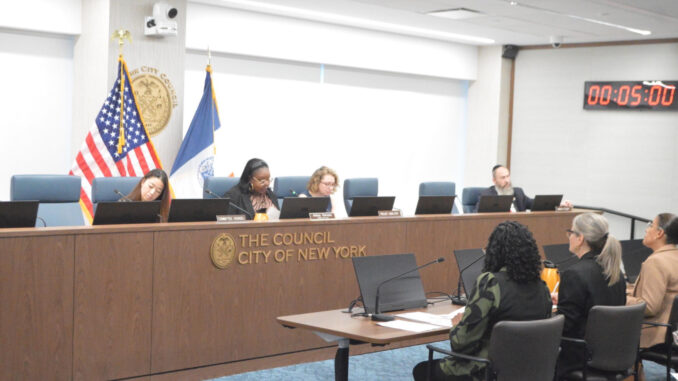
Councilmember Althea Stevens questioned the city’s Department of Youth and Community Development’s (DYCD) efforts to meet the needs of runaway and homeless youth at a hearing at on Tuesday. Stevens, who chairs the Committee on Children and Youth, grilled officials on discrepancies between policies she said make sense on paper, and their failure to help youth in the real world.
More than 154,000 children in NYC experienced homelessness in 2024, according to data from Coalition for the Homeless, an advocacy group. The group also found that 30,824 children stayed in shelters in July 2026.
“The city has resources, but we have to connect the dots,” said Samiha Khan Oishi, now 23, when members of the public were invited to give testimony. Oishi described her experience navigating the city’s shelter system as a 19-year-old on a student visa after being kicked out of student housing.
DYCD tracks the capacity of shelters in the city in terms of how many beds are available. Currently, there are around 900 beds across the five boroughs available for children and youth.
In addition to shelters, the city also offers drop-in centers, which are facilities designed to provide food, clothing, showers and laundry, and Transitional Independent Living (TIL) programs, which are meant to offer youth 16-20 years of age support as they search for permanent housing.
According to the DYCD website, youth are permitted to stay in shelters for up to 24 months at a time.
After that time is up, shelter staff will sometimes then re-enter a youth in the system in order to restart the timeline, explained Assistant Commissioner Samantha Dawkins.
Several in the assembled audience shook their heads, and Stevens mused why there was a policy for maximum stay in shelters in the first place. “I don’t like stupid stuff,” she declared, before proposing to agitate for a policy change at the state level.
Stevens also wants the department to have more funding for street outreach for young people who are homeless, including runaways.
There are currently two outreach teams for the entirety of the five boroughs, each consisting of four to five people in a van. As DYCD Commissioner Sandra Escamilla-Davies explained, one team covers the Bronx, Queens, and Manhattan above 59th Street, while the other covers the rest of Manhattan, Brooklyn, and Staten Island.
That comes out to about eight people covering all of New York, a city of more than 8 million, Stevens pointed out.
Stevens expressed her disbelief at the situation, pointing out the difficulty of a single outreach team, tasked with half of Manhattan and all of Brooklyn also meeting the needs of youth on Staten Island. “Are they swimming back and forth?” she asked, as laughter rippled across the room. “What are we talking about here?”
“I’m gonna ask the question, and then I’m gonna answer it, said Stevens, before asking if the agency needed more funding for street outreach, and immediately answering in the affirmative for them. “Do you need more funding for street outreach? Yes. Alright, so we did that part.”