
BY EMILY NIXON
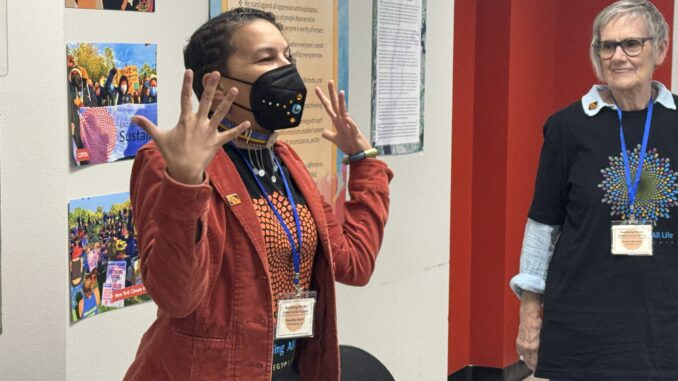
Climate Week is in full swing in New York City (NYC), and Sustaining All Life (SAL), a partner grassroots organization of Re-evaluation Counseling (RC), is taking a different approach to helping to solve the climate crisis. The two groups led a workshop on Sept. 22 at Berkeley College in midtown to offer tools and resources to activists to avoid burnout and make connections between the challenges of fighting racism and combating climate change.
“I think we all see [racism and the climate emergency] sort of passively, but sometimes you need to shine a light on it,” said Dyresha Harris, a volunteer delegate who helped lead the workshop. “One thing I haven’t really seen outside of [SAL] is a tool and a space to unlearn the things that we’ve learned that get in the way of our activism, and get in the way of us working well together.”
SAL focuses on providing emotional regulation and conflict tools to interested individuals and groups alike to unite them in their fight against the climate crisis, and support activists, new and seasoned alike. They utilize these connections to create an activism “network” and allow each activist to help in their own way.
“We want people to think for themselves what they think makes the most sense, and go out in the world and do it, and use us as your support base,” said Diane Shisk, a founding member of SAL.
SAL and UER provide these tools to ensure all solutions made by the movement are strong and inclusive of those it affects. Harris warns that any weakness threatens a proposed solution, either “festering” on its own or “can be leveraged or manipulated by people” opposed to the solutions.
During the meeting, the organizations led multiple “listening exchanges,” a tool used since RC’s founding in the 1950s, to combat emotional burnout and conflicts. Listening exchanges involve giving each participant equal, uninterrupted time to express their feelings about any given topic without criticism, comment, or judgment from the others.
While conversation about internalized racism is commonplace, the lack of conversation as to how to approach and solve the problem is a point of concern for Harris.
The workshops and tools, given by SAL and UER, provide the solution lacking from these conversations, “other than just noticing [internalized racism] and feeling bad about it,” according to Harris.
The workshop focused on building interpersonal skills and teaching methods to boost unification with those one might not necessarily agree with. Apathy is a “dangerous” part of the climate change conversation, according to Harris.
“Because we are actually connected, we‘re on one planet, so the more we stop caring about any group of people, and what happens to them, the more it spreads,” said Harris.
Racism and division stick with people long after the event happens, with the message internalizing in the person, according to Hoa-Li Tai, a volunteer delegate for SAL and UER.
Closing the gaps between people is critical to advance their activism, according to Tai.
“The ability to heal out hurts is what’s gonna allow us to build that mass movement of diverse peoples we need to build [despite] all the divisions there are currently in the country,” said Tai.
While SAL, RC, and UER do not have a solely political agenda as a support network, Tai believes the next step is uniting the people to pressure global political leadership to take action on solutions already envisioned by scientists and environmentalists.
“This might be the biggest human project ever. […] We know how to [solve the climate crisis],” said Tai. “So, what’s really missing is the political will.”
The support given by SAL, RC, and UER is at a critical time, according to SAL member Shisk.
“We encourage people to be both involved in this movement of emotional support, which we think is important, and some movement in the world,” said Shisk. “Because we think if we don’t change the world, we’re not gonna have it forever.”