
BY RIVER FLEISCHNER
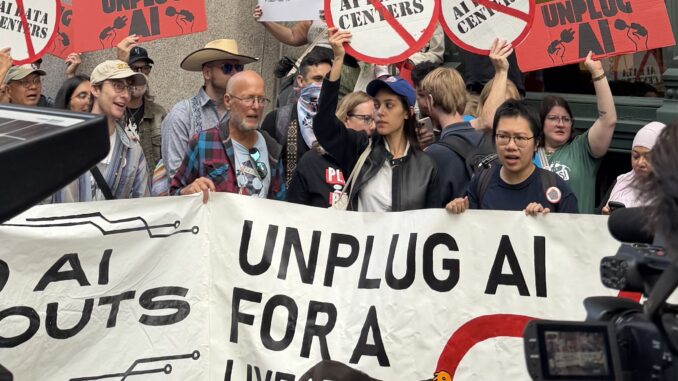
About a hundred people gathered outside OpenAI’s corporate headquarters in Manhattan on Monday to call attention to the threats AI poses and to demand that government pass data center moratoriums and regulations.
“OpenAI will have us believe its presence in our lives is an inevitability,” Justin Maxwell of Cincinnati-based Communities United for Action, told the crowd. “AI is not the solution, we are.”
The protest, part of Climate Week, was spurred on by reports of threats to the environment by AI, its integration into the US military industrial complex, and concerns surrounding the economic impact of investment in what may turn out to be an AI bubble.
In a rare instance of solidarity across the political spectrum, about 60 percent of Republicans, Democrats and Independents are united in their opposition to data centers, according to recent polling from PBS News, NPR, and Marist. “We didn’t ask for this,” said Maxwell. “We want clean air to breathe.”
According to Cleanview, which tracks US power infrastructure, there are 3,525 data centers in the US, with a global tally of 12,259. The Lincoln Institute of Land Policy, a non-profit focused on sustainable land use, has called AI data centers “resource ravenous”; In 2023, data centers in the US consumed 176 terawatt hours of electricity, roughly the same as the entire nation of Ireland.
OpenAI, which owns ChatGPT, has partnered with the Los Alamos National Laboratory to install its GPT models on the US government’s Venado supercomputer, which is used for nuclear stockpile management. Founded in 2015 by Elon Musk and Sam Altman, OpenAI is a nearly trillion dollar company with projects spanning from generative AI to weapons manufacturing and national defense.
In February of this year, OpenAI reached an agreement with the Department of Defense after its competitor Anthropic refused to, citing concerns of mass surveillance. Openai quickly deployed its models across the government’s classified network.
The website for Monday’s protest called attention to the fact that OpenAI President Greg Brockman donated 25 million dollars to MAGA, Inc. In February, Brockman told Wired magazine the donations were intended to gain favorable government support for his company.
In July, CNBC reported that OpenAI proposed handing a 5% stake in the company to the federal government. This would amount to around $42.6 billion of the company’s valuation of $852 billion.
The possibility of federal ownership of part of OpenAI is ringing alarm bells for some.
“There’s a massive bubble being built,” said Jonathan Westin, executive director of Climate Defenders. Westin sees striking similarities between this moment of AI investment and the prelude to the 2008 financial crisis. “Even the ai companies are admitting they’re not as healthy and profitable as they said they were.” Westin, who was a prominent voice during the Occupy Wall Street protests, explained that like the banks in 2008, AI giants, after taking heavy losses, will require bailouts from the federal government, with taxpayers footing the bill. “We just want the billionaires to pay for it themselves.”
In a viral resignation post on X, former Anthropic employee Jacob Kaczynski warned of “civilizational risks” of unchecked AI development, saying that neither Anthropic nor OpenAI were being transparent with the public, writing that a possible superintelligence “could kill us all by the end of the decade.”
Westin pointed out that the real threat lies in the powering of increasing data centers with non-renewable resources. “It’s not like they’re going to hack into something and send missiles,” he said. “The thing that will really destroy all of us is climate change.”
It’s not only threats to the environment or economy that have some suspicious of AI, however. Many are concerned with AI’s effect on mental health.
“Everyone I know who’s using AI, they get f#@king dumber,” said Jodie Evans, co-founder of Codepink, a peace advocacy organization. “I’ve never seen so many people get dumb so fast in my life.”
A study published by the National Library of Medicine found that extended use and exposure to AI chatbots “might trigger, amplify, or reshape psychotic experiences in vulnerable individuals.” In a landmark court case, the parents of 16-year-old Adam Raine sued OpenAI over the teen’s suicide, saying Adam’s use of ChatGPT encouraged the teen to take his life. OpenAI then moved to counter-sue the family over claims that Adam “violated” user agreements.
Evans, 72, is incredulous about the efficacy of protests like the one on Monday. She pointed to the 1.5 trillion military spending bill making its way through congress, which would use taxpayer money for AI defense contracts. Evans said resistance to the bill is missing from the conversation. “It’s about the do, not the chant,” she said.