
BY EMILY NIXON
Brooklyn College film students have begun voicing their concerns with a new wave of safety rule enforcement and adjustments that thesis films will face from the Film Department.
“I just think it’s unfair to the students that already shot this semester, and that are going to shoot this semester, and also those that are in screen writing for thesis [class],” said David Ceballos, a film student set to take screenwriting next semester. “Since they started the class with a different set of rules, and then midway through their semester, you have to completely change up a few things that may or not be crucial to the film.”
The BC Film Department has shared a list of safety rules students in film classes must comply with during their film shoots. Some rules include prohibiting filming on Metropolitan Transportation Authority (MTA) property; rooftop filming; nudity, sexual activity, or intimate scenes; as well as prop weapons on any student film set.
“Film production safety rules are an essential part of the professional industry. Academic programs must continually update their guidelines and safety training as industry standards evolve,” said BC Film Department Chair Sarah Christman in a statement. “The recent updates in the Film Department reflect this ongoing responsibility.”
Henry Checo, a senior film student who already went through the thesis process, found the MTA rule unfair to student filmmakers.
“I feel like it should be a rule that is less strict, not prohibited,” said Checo. “If we can talk to the chair to see if we can get permission or something to record on MTA property, that would be nice, but outright prohibiting it is, to me, quite unfair.”
BC Film Senior Amar Brion-Fernandez agreed with prohibiting filming on MTA properties.
“People who say, ‘why can’t we film on subways?’ said Brion-Fernandez. “If you want to have a set that is functioning properly, you need a specific amount of people. Think about all those people on a film set on an active, not just train, but like subway platform. You never know what’s gonna happen.”
Checo also found that the rule against nudity interesting, and offered an alternative to avoid censure of student films.
“The nudity one is a very gray area because there were students that did have nudity in their films, and they were quite explicit, but those students weren’t reprimanded and they were still showcased,” said Checo, “I don’t think it should be fully prohibited, but if it’s something more strict, like if their film is gonna involve nudity, you should have some sort of […] in the beginning of a film – ‘Viewer Discretion Advised.’”
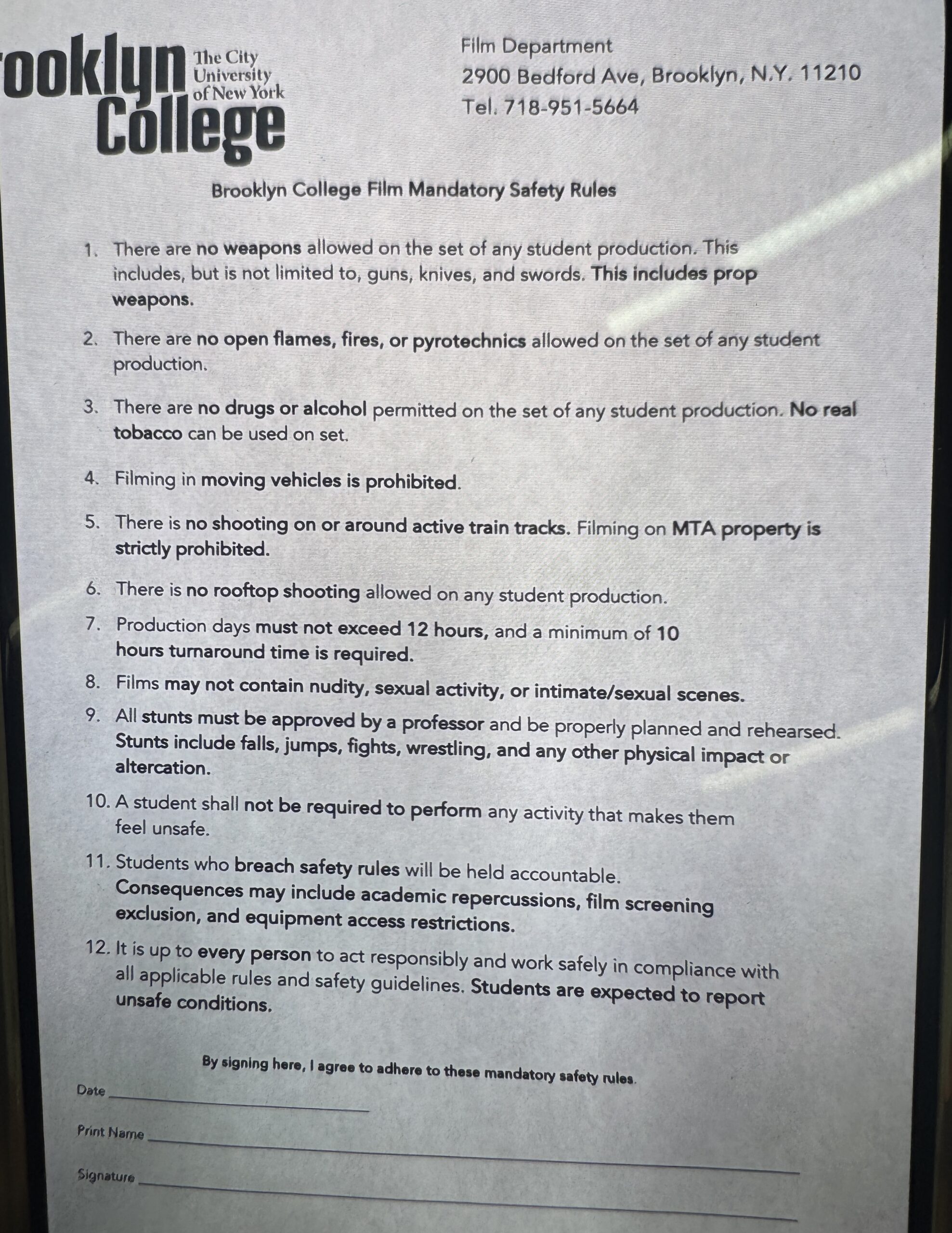
Students were first informed of the change through a town hall meeting held by the department administration on Nov. 3, according to multiple students who attended.
“The recent Town Hall is one part of a broader ongoing communication effort to keep students informed and engaged, including classroom visits from the Chair, faculty meetings with student filmmakers, and the establishment of a student advisory group,” said Christman in the statement.
Students learned about the town hall mainly through word of mouth and posters, according to Brion-Fernandez.
“Sarah [Christman] did admit that the rollout was a little hasty, and done out of precaution and safety, but um that the rules have been amended a little bit,” said Brion-Fernandez, recounting the town hall.
Brion-Fernandez recounted a pattern of past issues when students disregarded the previous list of rules.
“I think a lot of what these students don’t realize is that a lot of these rules were already in place, and they have been in place for the past several years,” said Brion-Fernandez. “It’s just the past department chair turned a blind eye and did not really – the rules were not enforced, and that’s why it’s very jarring to a lot of people – the immediate crackdown.”
While the film department holds classes that range from hands-on work to film studies courses, Brion-Fernandez said that the department should alter its curriculum to add more vocational training to the hands-on courses before students reach thesis level coursework.
“In the film industry, a lot of what we learn is on set. At the same time, I think that students deserve to be taught before they get to thesis, how a set should safely and properly function, and why these rules are in place,” Brion-Fernandez said. “Because if you just tell students, these are the rules and you have to follow them, and they don’t understand why, of course you’re gonna get pushback. Of course you’re gonna get comments about censorship when in reality these rules are here for a specific reason.”
The timeline for the new wave of enforcement is unclear as the rules are still being formulated, according to Brion-Fernandez.
“They’re not immediately being implemented. Sarah [Christman] and the faculty are working with their thesis production students to make sure that it is as fair as possible, while also still applying to the rules,” said Brion-Fernandez. “They understand that thesis is already a stressful time for students, and that they don’t want students to be even more stressed about this. They are working with students.”