
BY NOELLE RANGRAS
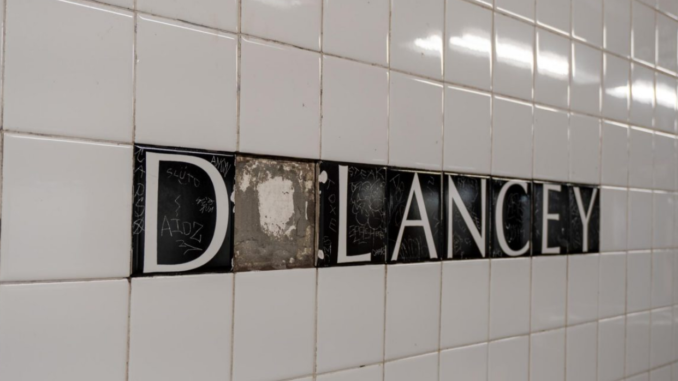
The Metropolitan Transport Authority of NYC removed a tile placed at Delancey-Essex streets station by artist Eujue Lee this past October. It subsequently rejected Lee’s broader proposal for local artists to replace missing Subway station tiles with art. The MTA said it does not accept ceramic installations.
Eujue Lee is a Brooklyn-based Korean-American product designer, ceramicist, and content creator. She started the ‘NYC Tile Watch’ initiative, which encourages New Yorkers to report missing or damaged tiles they notice at Subway stations– with the aim of local artists replacing them. Rather than reporting tiles as a maintenance request, Lee wonders if they can become “tiny canvases for artists to fill.” She created a website where New Yorker’s can report missing or damaged tiles with pictures and locations, and a form for artists who are interested in participating.
Over 2000 artists signed up, including Krystle Ramirez, a Brooklyn based graffiti artist. She believes a project like this will encourage artists around the city to stay dedicated to what they’re passionate about. “We need this.” Ramirez remarks, “With the AI everywhere? I see graffiti walls made by AI. It’s a joke.” According to the UN, generative AI is projected to drive significant income losses for artists by 2028, with a projected 21% loss margin for artists in the audiovisual sector. UNESCO Director-General Khaled El-Enany declared that the current era represents a critical moment for the creative economy. When discussing these numbers, Ramirez says she is
“not surprised”. “No matter how untalented people think i am,” she says, “a machine cannot paint the way I do.”
A week after launching her proposal, Lee was approached by NYC Mayor Zohran Mamdani’s team, who helped her get in touch with the arts & design office at the MTA to submit an official proposal. The proposal was rejected, a representative stating that the MTA’s arts & design sector is “limited to digital and graphic art, photography, poetry and music,” and that they are unable to feature ceramics. “There’s a lot of strict regulations,” says an MTA worker stationed in Lower Manhattan, emphasising that things have changed in the past 20 years, and just because something like this hasn’t been done before does not mean it cannot be done now. “We got more creative people willing to donate their time, I think that’s powerful,” he says.
This rejection did not discourage Lee. She continues to ask New Yorkers for help with her project, conducting $15 classes teaching interested folk how to make their own chia tiles. ”I recently visited Seoul’s ‘Wall of Hope’, where citizens contributed ceramic tiles to a public art installation,” says Lee, “my grandparents were a part of that. Seeing their contribution reminded me how meaningful it can be to literally leave your mark on a city.” Lee’s passion for her art is what keeps her determined to keep moving forward, even in the face of rejection.
“The art is the reason for everything, it’s why we keep going,” says Ramirez, “it is really disappointing and discouraging to see AI taking over everything.” She believes it is unethical to, “use a machine that steals our art to train itself and then literally steals from us,” in place of supporting human artists. “Do not use AI! if you need a custom art piece— commission an artist. I don’t care what it costs, find an amateur to do it complementary or cheap,” says Ramirez.
Lee is still in touch with Mayor Mamdani’s office, and is preparing a revised proposal to submit to the MTA.