
BY NICHOLAS GUMBS
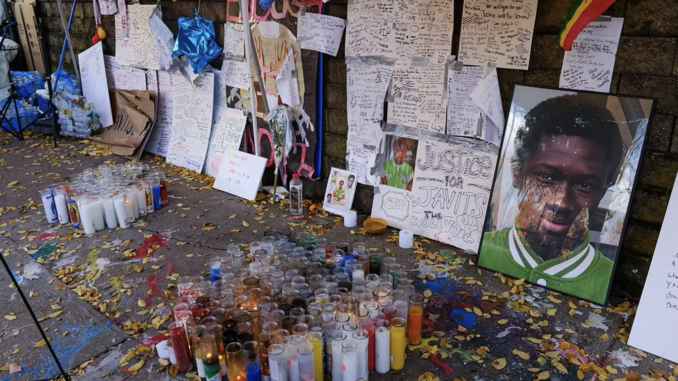
The fatal shooting of 15-year-old Ghanaian immigrant Javits Frimpong has left his family and New York City’s Ghanaian community grieving, raising concerns about the emotional toll of youth violence on immigrant families, as relatives demand justice and answers about allegations that the teenager experienced bullying before his death.
Frimpong was shot and killed on the morning of Thursday, October 29, while walking to school near Crotona Park in the Bronx. Surveillance footage captured a masked suspect wearing a black hoodie and sweatpants chasing the teenager. After running nearly a block, Frimpong collapsed from his gunshot wound. He was transported to St. Barnabas Hospital, where he later died.
Nearly two weeks after the shooting, the New York City Police Department arrested a 17-year-old suspect on Wednesday, November 11, in connection with Frimpong’s death. The arrest marks a significant development in a case that has devastated a family whose hopes for a better future in America ended in tragedy.
The killing has also raised concerns about youth violence, school safety, and the emotional well-being of immigrant families.
Margrethe Horlyck-Romanovsky, an Associate Professor of Health and Nutrition Sciences at Brooklyn College and director of the college’s Immigration Health Lab, is involved in the New York City Ghanaian Immigrant Mental Health and Wellbeing Project, which aims to address mental health stigma and improve access to culturally appropriate mental healthcare among Ghanaian immigrants. She described the emotional toll the killing has taken on the community. “People are distraught. People are questioning the choice to move to America… This was the dream of a family. This was the dream of a village that was ended so tragically… so the community is devastated. The community is also really angry.”
Horlyck-Romanovsky explained that many immigrant families make significant sacrifices to provide their children with better opportunities, making tragedies like Frimpong’s death especially devastating. She said the killing has also heightened fears among immigrant parents about their children’s safety, particularly the safety of young Black boys.
Frimpong had moved from Ghana to the United States in October 2025 to reunite with his father, Thomas Frimpong, continue his education, and pursue opportunities unavailable to him back home. He enrolled at The DreamYard Preparatory School in the Bronx, where his family alleges he had been subjected to bullying.
For his father, bringing his son to America was supposed to be the beginning of a promising future. “I brought Javits from Ghana to continue his education here in the United States… He was very, very, very excited,” Thomas Frimpong said during a press conference posted on ABC7 New York. “Unfortunately, on the 29th day of October, I was at work when I heard that my son had been shot.” Frimpong’s family traveled from Ghana. His mother, Doris Adu Gyamfi, is mourning her son’s death and seeking justice. His sister, Millicent Boateng, said Frimpong wanted to become a physician and join the military.
The shooting has also sparked outrage within New York City’s Ghanaian community, where families are confronting concerns about violence and the safety of their children. Professor Horlyck-Romanovsky said the tragedy has added to the emotional pressures immigrant families already face, while highlighting the importance of mental health support within the community. The Ghanaian Immigrant Mental Wellbeing Project works to reduce mental health stigma and better understand community experiences with stress, anxiety, depression, coping, and care-seeking.
She emphasized that older generations may be less comfortable discussing mental health, often relying on prayer and perseverance, while younger people are generally more open to seeking support. “Not all people feel seen or heard in the traditional medical care system,” Horlyck-Romanovsky said. She stressed the importance of culturally sensitive mental wellbeing services that recognize immigrants’ beliefs and experiences, helping families feel more comfortable seeking professional support. Ghanaian community organizations have responded through vigils, marches, and discussions about bullying and youth violence. Horlyck-Romanovsky also stressed the importance of schools and mental health professionals in supporting young people experiencing trauma.
However, she cautioned against speculating about whether the shooting could have been prevented, noting that the full circumstances remain unclear. She also pointed to the accessibility of firearms as a broader issue contributing to gun violence.
Meanwhile, the criminal investigation continues. According to ABC7 New York, police took the 17-year-old suspect into custody at the 42nd Precinct on Wednesday morning. The teenager, whose name has not been publicly released, faces several charges, including murder, manslaughter, criminal possession of a weapon, and additional firearm-related offenses. Police are also searching for two additional suspects believed to be connected to the shooting. Authorities have not publicly established a connection between the bullying allegations and Frimpong’s killing. Although the arrest marks a significant development in the case, questions remain about the circumstances surrounding his death, as his family continues to seek answers and justice.
For Frimpong’s family, what began as a dream for a better future in America has become a fight for justice. His death has also raised concerns about youth violence and school safety within the Ghanaian community. Despite the grief and anger surrounding Frimpong’s death, Horlyck-Romanovsky highlighted the community’s resilience as it continues to support the family. “The resilience and the strength of the African immigrant community should never be underestimated,” she said.
As the criminal case moves forward, Frimpong’s family continues to seek answers and accountability for the death of a teenager whose ambitions were cut short. A funeral for Frimpong is scheduled for Friday, November 20th.