
NOELLE RANGRAS
Seventy percent of fashion design and development jobs will be eliminated by 2028, the Business section of Vogue estimates, with major changes in the way brands market their products emerging in 2026. The latest advertising trend is using generative artificial intelligence for quicker and cheaper results. Fashion houses are catching up, and are increasingly using AI models for their promotional campaigns. Creatives in the fashion industry suggest it may not all be positive.
About You, a German fashion brand, has launched a digital imagery studio that relies solely on AI generated models, and has cut 90% of production costs. “We are saving so much money,” says Julian Jansen, vice president of marketing at About You. “You’ve always had this super fast world of e-commerce, and this super slow traditional world of photo shoots, it didn’t fit together in any way— and now with AI, it’s a completely different scale.”
Integrating artificial intelligence into product visualisation can help personalise the product to each part of the brand’s audience. H&M is using ‘AI Twins’ of real models, while Levi’s is using generative AI to showcase their clothing on different body types to promote inclusivity. Even high end, luxury brands, that can more than afford an entire editorial team, such as Burberry and Moncler are part of this new form of advertising.
AI enables brands to offer ‘virtual try-ons’ on their website, which is a major selling point in the era of online shopping. AI chat-bots can also help with customer grievances, returns and delivery related problems. While there may be several benefits of AI integration, fashion professionals are concerned about overuse.
Lily Good, a junior consultant for fashion houses, thinks that AI campaigns can have both positive and negative impact, but “brands rely too much on the sheer grandness of the ‘AI’ part of the campaign, and less on the actual experience and narrative.” She shares that while AI is great for data utilisation and organisation, it takes away from the “visual experience” of the product. “What speaks to me during a campaign is the time, effort, and creativity that took to launch.” says Good, “With a strictly AI generated final product, those attributes are taken away.”
With a significantly cheaper alternative available, brands are hesitant to pay for human creatives to work on their campaigns. H&M, a multinational clothing company from Sweden that sells fast fashion apparel, accessories, cosmetics, and homeware, is one of the most popular retail brands in the world. According to Forbes, H&M has a profit margin of $1.3 billion annually. Even with this profit margin, H&M has taken to using ‘AI twins’ of human models to scale product visuals and maintain consistent content across global markets. “We’re exploring emerging technologies like generative AI to amplify creativity and reimagine how we showcase fashion.” says Jörgen Andersson, the Chief Creative Officer at H&M. He says that the technology allows the brand to “enhance storytelling and find new ways to connect with our customers, while staying true to H&M’s style-led, human-centric identity.”
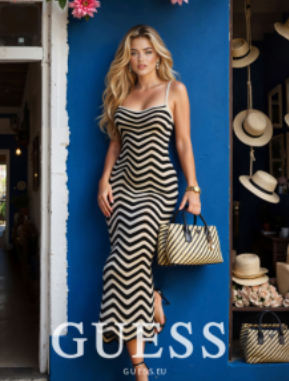
However, consumers have mixed feelings about AI modelling the clothes they are considering purchasing. A two-page advertisement for clothing brand Guess sparked major controversy last August, for featuring AI generated models in Vogue magazine. While there is no official number, hundreds of Vogue readers posted screenshots of their cancelled Vogue subscription on X and Reddit, emphasising their outrage. TikTok user Payton Wickizer, who creates lifestyle content, exclaimed that she was “speechless” about “the fact that they are using fake women in their magazines.” TikTok fashion influencer Marissa Spagnoli also claimed that “this doesn’t make us want to buy anything.”
In an interview with Good Morning America, co-founders Valentina Gonzalez and Andreea Petrescu of Seraphinne Vallora, the AI marketing agency that ‘produced’ these AI models, said that “The heart of fashion is photography. We will never challenge that.” They claimed to “only supplement the vision of the client.” Both Guess and Seraphinne Vallora were criticised on the promotion of unrealistic beauty standards, which can have a negative impact on young, impressionable readers. “What do people respond to? Beautiful women, things that look surreal, things that are very stunning,” Gonzalez said, “If you had responded to other types of beauty, we would have done that.”
Creatives in the fashion space, including photographers, models and photo and video editors feel similarly. Kaleigh Zehnder, a digital art and design student at the School of Visual Arts in Manhattan, says that it “terrifies” her to think of a world where people are unable to tell the difference between human art and AI generated art, “In every instance where AI is used, the task or even entire job of a real, human artist is taken away.” Zehnder says that AI generated fashion
campaigns imply to her that the brand is “cheap”. “AI art screams low quality because it is inherently the lower effort method, only a few lines of a prompt versus hours of hard work.”
According to the US Bureau of Labor statistics, the US has lost more than 200,000 jobs in creative industries over the past four years, the period since the first version of ChatGPT became available to the public, with almost 50,000 of those losses coming in the last year alone. Overall, creatives seem to unanimously agree that while AI can have it’s positives, it is overall a threat to artists. Good says, “I don’t like them. Every time I see them I just think, ‘okay, a human could’ve easily done this.’ Creativity and effort is noticeable.”