
BY GIANCARLOS ASENCIO
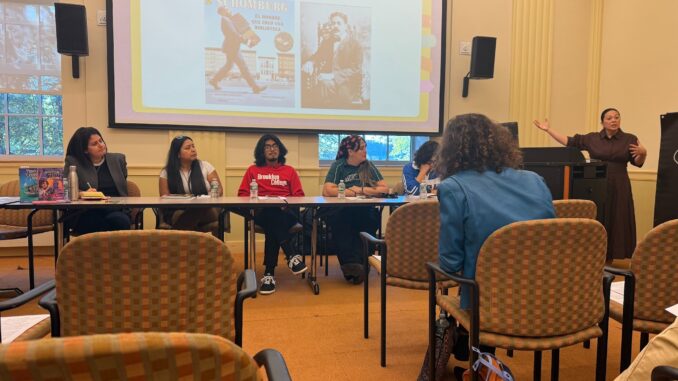
Bilingual educators met at Brooklyn College on October 7th to discuss the climate for bilingual students in public schools and how to better equip them.
Bilingual education is teaching academic subjects in two languages. According to Gitnux, a market research and statistics website, 76% of U.S. students who are English language learners receive bilingual education services in U.S. public schools. These students need different tools, including translated versions of books, assignments, and more.
Carla España, an assistant professor of Bilingual Education and researcher with Puerto Rican and Latinx Studies at Brooklyn College, said, “Most of my students here at Brooklyn College tell me that their first time, their entry point learning about children’s literature, is through this picture book we read.”
Educators at the conference said these books and resources have to be available to bilingual students earlier so they don’t get left behind. Luis Tapia-Alfardo, a Mexican-American Brooklyn College senior, believes these bilingual resources would’ve been useful if he’d had them in his younger years. “My old schools never offered me any bilingual courses or resources.” He added, “It would’ve been helpful if those resources were accessible.”
Teachers are also finding it hard to fit these learnings into the curriculum, and bilingual teaching across different formats seems to be facing pushback. “I think that we are in many ways facing a lot of challenges,” said Emma Otheguy, a bilingual children’s author and historian. “I know many of the teachers mentioned curriculum challenges toward getting these books into their hands. I see on the publishing side serious obstacles to what I would call our book culture.”
Elementary schools may struggle to offer bilingual programs at all because of insufficient staff and curricular materials, according to Ileana Najarro, a writer at Education Week. Without these resources, bilingual students get left behind. However, Otheguy believes solutions exist.
“I went to back-to-school night, and I met my daughter’s new first grade teacher…She said the most important thing you can do is to be a reader yourself. She told us that she reads from a book five pages every single day,” Otheguy said. “She won’t go to bed until she has finished her five pages. She recommended a book for parents to pick up, and I thought that was one of the most inspiring examples.”
As schools struggle to provide bilingual students with sufficient programs and resources, parents have to take the initiative and become teachers themselves.
“As a parent, for my child to have somebody who is modeling, I am bilingual. I’m Latina. I’m part of my culture,” said Otheguy. “I seek out books that interest me, and I am a reader myself, so that I can model what it means to be a reader for my students.”