
BY: BARBARE AKHALKATSI
Following a spring 2026 New Labor Forum article examining the gig economy and worker organizing, CUNY School of Labor and Urban Studies hosted an event where speakers discussed the future of gig economy. Lina Moe, a co-author of the article and a research fellow at the Federal Reserve Bank of St. Louis, moderated the forum.
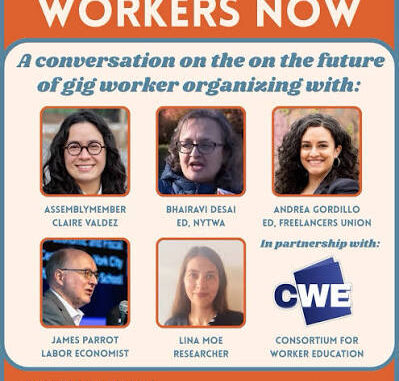
The event, “We Are All Gig Workers Now: The Path to Full Labor Rights,” was held on Oct. 6. at the school’s Midtown Manhattan campus and featured labor economists, assembly members and researchers to explore different approaches regarding the growing issue.
Bhairavi Desai, executive director of the New York Taxi Workers Alliance, questioned the flexibility promoted by ride-hailing companies. Drivers must work around rush hours and passenger demand to earn enough. “The hours of your work are not controlled by anything except the streets themselves,” Desai said.
The heated disagreement started over whether organizing should prioritize acknowledging self-employed workers as employees or pursuing collective bargaining rights for workers who consider themselves independent contractors.
Gabe Morgan, executive vice president of 32BJ SEIU and director of the union’s Pennsylvania and Delaware region, defended his union’s approach in Massachusetts, describing a model that allows ride-hailing drivers to organize and bargain across the industry without resolving their employee status under state law. Morgan argued that workers need organizations that finance them to win protections. He said the Massachusetts model gives workers a voice in contracts, strikes and union representation.
According to Desai, easier access to collective bargaining for institutions is different from workers achieving power. She said that access to bargaining alone does not guarantee worker power. Arguing that minimum standards and democratic representation must underpin negotiations, and questioned approaches that make organizational recognition easier without building a strong base of workers, Desai also remembered how her organization had fought for in New York, for minimum pay standards and paid sick leave for app-based drivers. “I don’t think hardship is the reason for us to make compromises.”
James Parrott, a labor economist and senior fellow at The New School’s Center for New York City Affairs, explained that gig workers are misclassified as independent contractors. He challenged the idea that gig work is mainly a source of extra income. For example, many drivers depend on it to support themselves, while companies shift business expenses onto workers. “The use of gig work provides tremendous advantages to employers, as it offloads all the traditional workers’ rights, that workers have secured through struggle over the past century, to the workers themselves,” Parrott said, “It turns out to be a big cost saving move for employers.”
New York State Assembly Member Claire Valdez urged the labor movement to pursue federal labor-law reform while continuing to organize locally. According to her, people are committing a lot of their time during delivery work, driving, freelancing, etc., but they don’t have theh same protection as full-time workers. “Companies are taking bigger and bigger cuts,” she said, “People that should have healthcare, dental insurance, PTO – their days are being wrapped up in work that has no protection or wages. These workers are being completely abandoned across so many sectors.”
Andrea Gordillo, executive director of the Freelancers Union, also called for stronger protections for freelancers and independent contractors. She said independent work should allow people to set their prices, choose clients, maintain their own client relationships and leave without punishment. “I see taxi workers, I see artists and people in journalism, who are all excluded from what should be a human right – healthcare, insurance, retirement plan, unemployment, etc.” According to Gordillo, freedom is missing for many gig workers.