
BY NOELLE RANGRAS
“The five scariest words in the English language are, ‘Your ConEd bill is ready!’” Said Chi Ossé, the City Councilmember representing Bedford-Stuyvesant and North Crown Heights at New York’s first ever Utility Ripoff hearing in Bedford-Stuyvesant on October 6th.
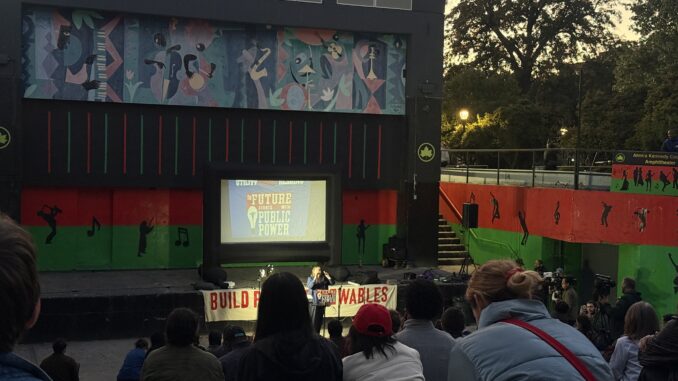
Public Power NY is a statewide, grassroots movement of New Yorkers who aspire to take their power back from corporate control. They sponsored the hearing, which was held at Herbert Von King Park’s amphitheatre, with over 70 attendees. Representatives claimed that New York’s energy system is leaving residents with exorbitant bills, amid angry accusations of a higher amount every year.
ConEdison, a major energy company that provides electricity, natural gas, and steam to about 10 million people, and is the main energy provider in NYC, has users complaining of feeling ‘ripped off’ while paying thousands of dollars for a service that is irregular and unreliable. To address this
“crisis”, Public Power NY hosted a public hearing, inviting New Yorkers to share their “utility horror stories” with ConEdison and describe the environmental impact that investor owned energy providers have.
Josh Karen, a Brooklyn College alum who works closely with Public Power explained that the goal for this event was to bring the community together to share their experiences, and explain how the inflated bills are going into the pockets of corporate subsidies while New Yorkers suffer through black outs and power outages during extreme weather.
“Our utilities are out of control, we are being ripped off, and our wallets feel it.” said Ossé. He commented on communities in Bed-Stuy and Flatbush that went without electricity in 30 degree weather last winter. “ConEd was unresponsive, and there were no refunds provided for the hours spent in black out.”
Jeremy, who did not provide a last name, is a resident of East Queens who reported having to go on a payment plan to pay off his $3,100 ConEd bill, while ConEd CEO Tim Cawley received a 5 million dollar raise this fiscal year. He also spoke about individuals on life-sustaining medical technology such as ventilators and dialysis machines potentially losing their life due to power cuts “There is zero accountability being taken, this is a broken system.”
Assembly member Sarahana Shreshtha, representing the Hudson Valley district of New York, explained that companies like ConEd are a “natural monopoly” that have no competition. Shreshtha reported that ConEd’s return on equity rate rose from 9.25% to 9.5% this fiscal year, which raised their profits by 113 million dollars. ConEd’s proposed rate, however, was 10.1%, which would have raised their profit margin by a whopping 190 million dollars. Shreshtha called investor-owned utilities a “scam,” before introducing her Hudson Valley Power Authority Act Bill, which proposes to dissolve and replace the privately owned Central Hudson Gas & Electric Corp with a public, nonprofit, democratically governed power authority. She described her bill as being “designed for the profit of people, not shareholders.”
Emily Gallagher, the New York State representative for Greenpoint and Williamsburg, shared that Greenpoint is “the most environmentally compromised region in the United States due to the oil industry.” Newtown Creek, an estuary off the East River has been storing liquified gas for Long Island for over 100 years. State representatives claimed that holding oil companies responsible for cleaning up the mess they leave behind only results in them declaring bankruptcy to avoid fines and clean-up costs. “The planet is burning,” said Gallagher, “we are struggling to stay housed and clothed and warm. It is not enough to be upset. You should be enraged.”
In a statement quoted by Pix11, ConEd defended their practices by stating, “We’ve provided more than $500 million in discounts to income‑eligible customers over the past two years, expanded our energy affordability programs, and continued offering flexible payment options to ease the burden.” A spokesperson added that the company is investing in the grid to maintain reliable service and build clean energy systems.
Faroud, a resident of Bed-Stuy, concluded the event with an emphasis on the need to speak up, make your voice heard and protest against the current system. “Silence protects this system. Anger leads to power, and power brings change.”