
BY SERENA EDWARDS
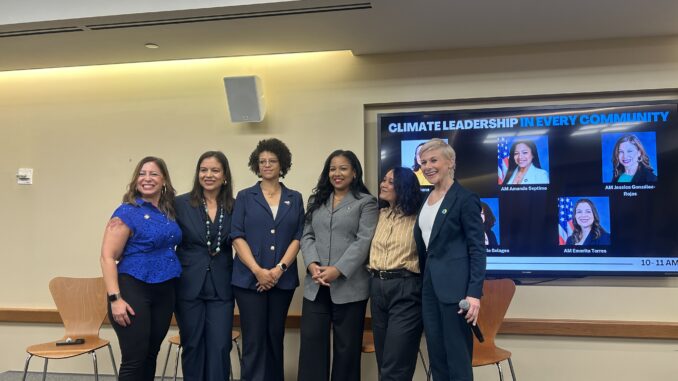
During this year’s climate week in New York City, Environmental Advocates NY collaborated with the NY Black, Hispanic, Puerto Rican and Asian Legislative Caucus (NYSABPRHAL) to highlight the effects of climate change on marginalized communities in New York.
The panel was convened by Environmental Advocates NY, which lobbies for environmental justice in underrepresented communities.
Danny DaBare, the operational organizer of the event said, “Often local communities that are not immersed in the up to date climate news are left out of the conversation. This panel is really a moment to bring in voices that are often left out of the Climate week, that are black and brown, and don’t think of climate as a first priority.”
DaBare explained how the community can advocate for themselves and also connect with their elected officials. “Oftentimes, there’s a big disconnect between Albany and New York City, and by building that bridge through events like these, we were able to really draw the dots between the two geographies.”
The panel included members of the New York Assembly – five women representing the Bronx, Queens, and a section in Manhattan; and the Hudson Valley. All of the panelists were part of the NYSABPRHAL caucus, and emphasized their concerns around environmental injustices they have seen in their communities.
NYSABPRHAL is a nonprofit organization that represents the legislators within these marginalized communities. With a body of 80 members, they are a part of the NY legislative branch and connect with each other to strengthen their advocacy.
Moderating the panel was the Vice President of Environmental Advocates, Vanessa Turner and NY Representative Michaelle Sogales. Representative Sogales spoke about the intersectionality within these issues. “Right now we’re in the middle of a climate crisis, but an affordability crisis and they are intertwined and we need to look at it that way,” she said.
The first issue they took up was the increase in flooding in the city.
Assemblywoman Jessica Gonzalez-Rojas represents neighborhoods in Queens includin: Astoria, Corona, East Elmhurst, Jackson Heights, and Woodside. Gonzalez-Rojas stated specifically in Queens how her residents have been affected since Hurricane Ida in 2021. “In 2021 we experienced rapid flooding. It was about 3 to 5 inches of flash flooding our communities experienced. There were about 11 people that died in Queens from Hurricane Ida,” she told the panel.
The panelists also touched on a rise in respiratory issues such as asthma. With many residents living near highways and busy roadways, the air quality is depleted. In efforts to combat this, Assemblywoman Torres introduced a bill she hopes passes to prevent these issues. “I introduced a bill last year related to highway expansion called Highway Community Harm Act, where you cannot expand a highway that is one touching a zip code that has a very high rate of asthma or is near a public housing facility,” she said.
Infrastructure was another topic of discussion, with many assemblywomen mentioning that a lot of the solutions can be fixed with new infrastructure. “It is the infrastructure investments that we need to have and the climate policies that we need to advance to really have a solution to the issues that communities like mine face,” stated González-Rojas.
Representing the Bronx, Assemblywomen Amanda Septimo and Emérita Torres talked about the intersectionality they have seen within their districts. Though they represent different parts of the Bronx, one neighbor they dually represent is Hunts Point. “In the Bronx, climate change is not an existential question. You don’t have to really reach far to make the connection because it is always present,” stated Assemblywoman Septimo.
“Now what you see happening with climate change is exacerbating these issues […] we see an increasing frequency of days over 100 degrees.
A common factor mentioned was the SLCP rollback which caused a lot of things to be reversed. However, the assembly people don’t want this to cause communities to lose hope.
Asm. Sogales spoke on the importance of community movements and how their voices play a role in this. “This work is not just done with the government. It’s done with community advocacy and alliances that are created that identify issues and work towards a common goal.”