
BY NICHOLAS GUMBS
Unions leaders, educators and civil rights organizations urged Gov. Kathy Hochul Wednesday not to participate in a new federal scholarship tax credit program that they argue could undermine public schools and worsen educational inequalities.
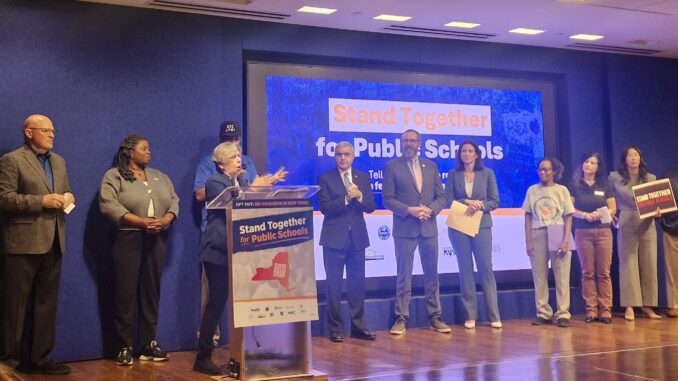
Representatives of the United Federation of Teachers (UFT), NAACP New York State Conference and American Federation of Teachers (AFT) gathered at UFT headquarters in Lower Manhattan to press Hochul to reverse her support for the program.
The Federal Scholarship Tax Credit was enacted by Congress as part of the One Big Beautiful Bill Act, which President Donald Trump signed into law in July 2025. A similar federal scholarship tax credit proposal had previously been promoted in Project 2025, the Heritage Foundation-led conservative policy agenda developed ahead of Trump’s second term. Project 2025 called for a federal tax credit to encourage donations to nonprofit scholarship-granting organizations that could fund expenses including private school tuition, tutoring and course material.
The federal program is scheduled to begin January 1, 2027. Individual taxpayers may receive a federal tax credit of up to $1,700 for qualifying cash donations to nonprofit Scholarship Granting Organizations, or SGOs. Those organizations would use the donations to provide scholarships for eligible K-12 students.
Unlike traditional voucher programs, in which government money is provided more directly for families to pay educational expenses, the federal program uses tax credits to encourage donations to scholarship organizations. Scholarships may be used for private school tuition as well as certain educational expenses that can benefit public school students, including tutoring and other services.
New York has not formally opted into the program, but Hochul has indicated that her administration intends to participate while awaiting additional federal regulations.
UFT President Michael Mulgrew expressed hope that Hochul will reconsider.
“We’re just hoping that she continues to have an open mind and hears us,” Mulgrew told reporters.
Although the federal credit does not directly reduce New York’s existing state or local public school budgets, opponents argue that subsidizing private education could encourage students to leave public schools, potentially reducing enrollment and affecting school resources over time.
AFT President Randi Weingarten also argued that public schools must educate students regardless of their needs while private schools can choose which students they admit.
“The fundamental difference between public and private schools is this, we educate everyone, said Melinda Person, president of New York State United Teachers (NYSUT).
Weingarten stated that these programs will prioritize private schools. “Vouchers are about allowing private schools to pick and choose who they admit, leaving the most vulnerable children behind”, pointing to voucher programs in Arkansas and Arizona as warnings about the potential effects of expanding school choice.Those state programs are separate from the new federal tax credit program, which has not yet taken effect.
NAACP President L. Joy Williams called it a “tax scheme”, saying that investing in the program won’t benefit students, but rather lead to divestment from public schools.
Hochul’s administration has defended participation, arguing that the program could benefit both public and private school students without reducing existing state or local education funding. A spokesperson for Hochul said, “Governor Hochul’s priority is making sure every student receives an education that best meets their needs, which is why she wants the federal scholarship tax credit to benefit all New York students”, indicating that it won’t affect preexisting or future finances.
Supporters like the New York Educational Opportunities Coalition, NYC parents and Republican Lawmakers like Congresswoman Claudia Tenney have also urged Hochul to participate. A coalition of community organizations and charter-school advocates argued this month that the program could provide additional resources for tutoring, after school programs, special education services and other educational supports.
The debate leaves Hochul to decide whether New York should participate in a federal program that supporters view as an additional source of educational resources and opponents argue could accelerate movement away from traditional public schools.