
BY ESTHER BOILEAU
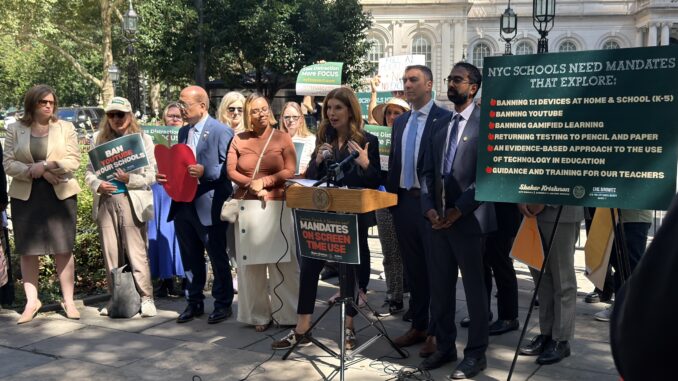
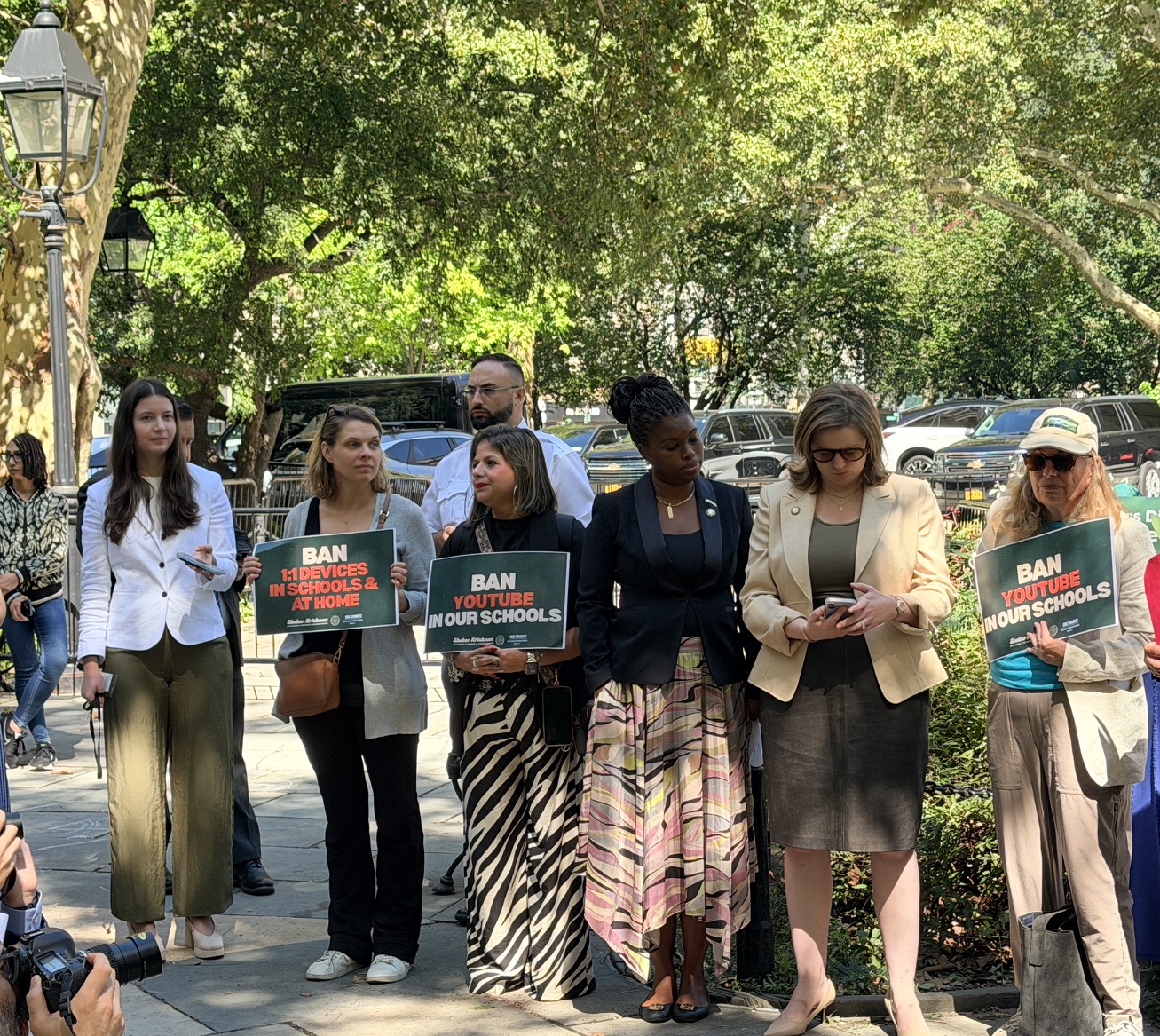
Council members, parents and advocates came together outside City Hall on September 15 to urge the Mamdani administration to adopt more stringent guardrails on computer technology for public school students, starting with children in classes K- 5 grade ahead of the 2026-27 school year.
The call to action comes following a drop in test scores.
The rally comes two weeks after Mayor Mamdani and schools Chancellor Kamar Samuels put in a one year moratorium to ban the use of generative AI for children in grades 2K-8. The Department of Education will revisit the policy throughout the school year.
Councilmembers Shekar Krishnan, Eric Dinowitz, and Julie Menin led the rally, calling for bans on YouTube and gamified learning, and a return to pen and paper testing. “Everything we give our children is evidence based,” said councilmember Dinowitz while calling for the Department of Education (DOE) to show the evidence of education technology or “ed-tech,” and how this is either helping or hurting the students.
Julie Menin took the podium to explain the consequences of too much screen time, sharing that proficiency scores for students in 3 through 8 grade have dropped since 2024.
Parents were concerned about tech companies’ access to and information about children through these big ed-tech platforms. “ i-Ready currently has two major lawsuits against them for violation of privacy laws, ” said Kaliris Salas, a mother to two boys and the president of the Community Education Council in District 4 or East Harlem. Salas states many parents, teachers and students have come into these meetings stating how the children feel as though they are spending more time with the screen than their teachers.
Right now the moratorium includes screen time caps on certain grades. Students in grade Pre-k through second grade will lose their screen time altogether. Students in grades three through five will have 30 minutes of screen and students in grades six to eighth will have 45 minutes. Those in high school can still use AI technology platforms geared towards career placement and development. Although the policy is only for one year, if successful could be implemented into all classrooms.
“We don’t hate ed-tech,” said Dinowitz. “We just want to see the evidence behind these platforms.”