
BY NOELLE RANGRAS
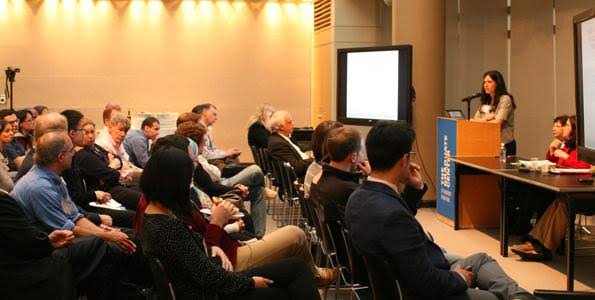
LGBTQ+ business owners shared their experiences at the National LBGTQ+ & Allied Chamber of Commerce New York’s 2026 Summit on Economic Impact at the Manhattan CUNY Graduate Center last Wednesday. Queer entrepreneurs from all walks of life discussed how they came about starting a business, the impact of representation and local community support.
The event was led by Manhattan Borough president Brad Hoylman-Sigal and Barton L. Jackson II, who was recently appointed as the Executive Director of the National LGBTQ+ and Allied Chamber of Commerce New York. Hoylman-Sigal opened the summit by showing appreciation to LGBTQ+ business leaders that drive our community forward. He focussed on the importance of community, and described New York City as a “safe haven” to LGBTQ+ folk. He discussed the recent book ban that has affected several American states, as well as the denial of basic human rights to trans and queer children. He proclaimed that New York City will never be one where queer folk are afraid to raise their children. New York City Comptroller Mark Levine also made an appearance to greet speakers and guests.
Hoylman-Sigal then introduced Steven Garibell and Christina Calisi to the stage, who spoke about what it means to be visible as an LGBTQ+ company. Garibell currently works as the Vice President of Business Development at TD Bank. Calisi is the founder of Christina Calisi casting. She was responsible for platforming the first ever trans casting professional on Broadway, which she referred to as ‘her first moment of true success’. Calisi spoke about the power of impact, and expressed that she saw stepping into the spotlight as a means to create platforms for others like her. “If you can’t see it, you can’t be it.” She talked about the various challenges queer people
face when it comes to casting- with the world asking questions like, “how do we know they’re queer?”. Garibell emphasised the importance of community, and the impact of seeing diversity in those who succeed. “Visibility isn’t vanity,” he said, “It is a double edged sword, and we have to do the best we can to overcome the scarcity mindset and stand up for our community, for those who do not have the same resources and opportunities.”
Jeffery Garcia, the executive director of the New York City office of Nightlife, then introduced a panel of LGBTQ+ business owners in the food & beverage industry. These individuals further confirmed the vitality of community as small business owners belonging to a minority. Mario Vivas, the owner of Criollas, a baked empanada restaurant in Columbus Circle, spoke about the struggles of starting a business during the pandemic. “The most valuable thing I had then was the advise of other small business owners in NYC.” Arnyce Foster-Hernandez, owner of Featuring The Cafe, a gourmet coffee shop and community cornerstone in Harlem, spoke about the importance of a woman owned, black owned, LGBTQ+ space in her small Harlem community. “Growing up, there was zero diversity where I grew up, which is quite the opposite of how things are now,” said Foster-Hernandez.
Christopher Taylor, co-owner of Li-Lac Chocolates, admitted to feeling a weight on his back from taking over a legacy company. Li-Lac Chocolates has been an NYC staple for over 103 years, dubbed ‘the gay chocolate’ by generations past. Taylor spoke about the risk that came with making changes to the branding that consumers have loved for decades, and how his community truly came together to ensure the chocolate empire does not melt. He joked that he was encouraged by his partner to take over ownership of the company,”I told him, ‘you don’t really want me to have the company, you just want to eat the product.’”