
BY EMILY NIXON
The New York City Council unanimously passed a bill on Oct. 7 that requires the Mayor’s Office of Childcare and Early Childhood Education to study how language barriers affect pre-school children’s access to gifted and talented public childcare programs.
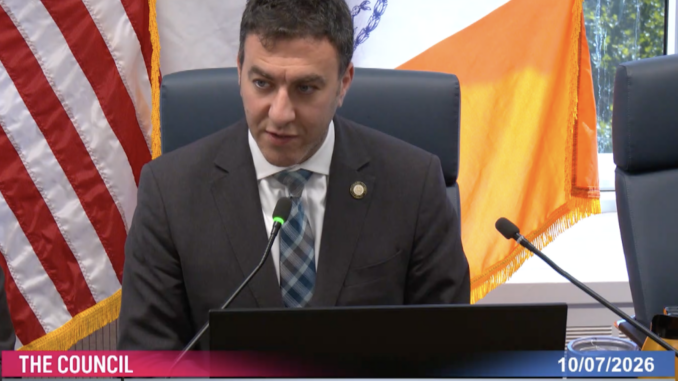
“Before enrolling a child in kindergarten, families must know that early elementary gifted and talented programs exist, understand how a child may be considered, and navigate deadlines often in a second or third language,” said Committee on Education Chair Eric Dinowitz at the vote. “Whether a family gets through those steps should not depend on the language spoken at home or the neighborhood they live in. Yet, today, the city cannot tell us whether it does.”
Gifted and talented programs identify children as young as five years old and offer “accelerated instruction” in New York City. In his campaign for Mayor, Zohran Mamdani announced that he planned to phase out these programs in a similar fashion as earlier mayors, according to an Oct. 2, 2025, article by the New York Times.
Gifted and Talented programs’ lack of representative enrollment have been controversial for decades as a method of promoting elitism, according to many critics.
The Coalition for Asian Children and Families, the nation’s only pan-Asian children and families’ organization, released a study in September 2025 which found that more than 10,000 students and families “receive little or no translated information” from NYC schools.
“Currently, the city mandates that schools translate official materials into a select list of 12 languages,” stated the study. “However, more than 10,000 students speak languages that fall outside this list—including many languages spoken within AAPI communities,” including Vietnamese, Hindi, and Samoan, among others.
The bill aims to recognize and close this gap for students and families that are not native English speakers, a “critical” step “to ensuring a thriving and successful school system,” according to Dinowitz.
The NYC Comptroller ? released an audit report in September 2025 where it found the DOE had failed to comply with state regulations and its own internal policies “regarding the identification of English Language Learners, program placement, service provision, and records retention.”
The report found that the DOE failed to “provide a significant percentage of ELLs with required courses,” “satisfy minimum instruction times,” “ensure that [ELLs] were taught by appropriately qualified teachers,” and ensure that certain ELLs were placed in the right program to begin with, among other issues.
“Every family deserves an equal opportunity to understand and navigate the current process,” said Dinowitz. “Access to an existing public school program should not depend on a family’s zipcode, or how well a parent speaks English.”
Councilmember Susan Zhuang was the primary sponsor for the bill and the only person other than Dinowitz who spoke before the council vote. The measure will open doors for students and families alike, Zhuang believes. “Too many families, like immigrant families, low-income, and minority families, face barriers that can make these opportunities feel out of reach,” said Zhuang. “Every child in New York City deserves a fair shot at a great education.”