
BY ALFONSO ABREU
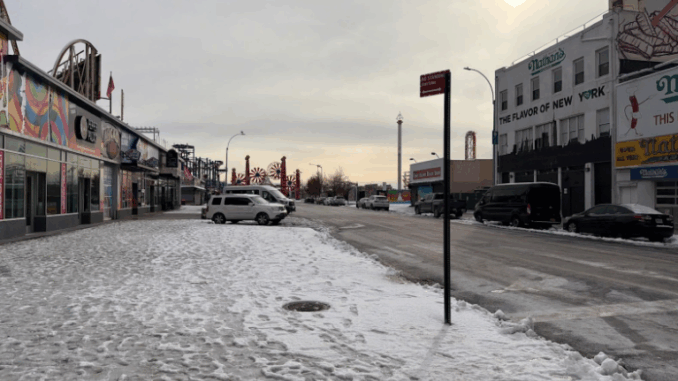
New York City is dubbed the “city that never sleeps,” operating twenty-four hours with no breaks. But Coney Island, wide awake in the summer as an iconic tourist destination, sleeps during winter, until the scorching heat returns.
To most New Yorkers Coney Island is the beach, the Cyclone and Luna Park. It is constantly labeled as a summer attraction. Summer crowds jump around from the boardwalk to the rides to local dining options. All day, the MTA’s Stillwell Avenue station brings waves of visitors, who follow the same routine as those who arrived earlier. It is the season where businesses, both corporate and local, are able to thrive off the large crowds.
But after the summer, foot traffic diminishes to a trickle of local residents taking the subway to work. The long lines are reduced to three to five people. Business operating hours, which once stretched from noon to midnight or beyond, now end by 10pm. Local businesses, without a brand name to carry them through the off season, close early or shut down entirely. Surf Avenue at night becomes a deserted, quiet space.
Two related development plans are in the works that might swell Coney Island’s resident population and maybe draw visitors to Coney Island in the cooler months.
On December 11th, a one billion dollar reconstruction for the Coney Island boardwalk was approved, according to Grace Tang, program director at the New York City Department of Parks & Recreation, who spoke at a Community Board 13 meeting. The plan includes renovating the boardwalk using existing materials, replacing broken wood panels and unleveled concrete floors.
“Once design kicks off, we’ll reach out and work with the Community Board 13, New York City Housing Authority, the alliance of Coney Island, the Aquarium, and many others,” Tang said. Aside from offering new housing space, the ground floor of these new buildings also includes space for businesses to build new restaurants. As of now, there is an Asian cuisine restaurant being built in the space, adding more restaurants in the area.
The boardwalk renovation is part of the “Coney Island West” plan, first announced by NYC Mayor Eric Adams in 2024 that also includes 1,500 units of new housing and an upgrade to the sports center. Mayor Adams said, “We are delivering mixed-income affordable housing, investing $42 million to renovate Abe Stark Sports Center, and making significant improvements across streets, sewers, and the public realm. Coney Island’s best days still lie ahead, and today, we are starting the next chapter of its bright future.”
The plan intends to encourage local business and address many issues that were caused by Hurricane Sandy, as the storm’s impact on the area is still present to this day. But the Coney Island West plan also stirs fear of gentrification.
Rosalina Khanis, a longtime native of Coney Island, said, “When I was little there were a lot of mom-and-pop shops and overall family-run businesses where everyone knew each other, and now it feels more commercialized, where it’s for business rather than being a community.” Khanis added, “Gentrification, on one point, is ok to bring in more younger people, but on the negative side, the sense of community really goes down.”
Some businesses, though would be welcome. The current Coney Island area lacks 24-hour delis. Delis on Surf Avenue close down for the night by 11pm. As of now, there is only one deli open for twenty-four hours. The deli is located next to the Coney Island-Stillwell Av, and a worker, Jaheem, who preferred to not give out their last name, said, “People come to us because we are the only deli open all day and all night. MTA workers getting off work come here instead of McDonald’s. We’re the better option.”
Ruby’s, a popular family-owned restaurant, may also benefit. A former worker, Brandon Zayas, commented, “Rudy’s will only benefit from any change happening to Coney; the place has been in business for decades and is considered a local landmark.” Ruby’s is currently closed for the winter season.
One development plan was recently defeated: the plan to introduce a casino. The selling point for the community was that a casino would boost the area’s economy by attracting year-round foot traffic. The casino proposal encountered pushback from Brooklyn’s borough president, Coney Island’s community board members, and City Council members. Talks regarding the proposal have lingered in the air since 2022, but finally, in 2025, the casino idea was shut down. Dubbed as a victory for the community.