
BY KAILA MACEIRA
New York has the highest concentration of Puerto Ricans in the world outside Puerto Rico, but Puerto Rican Studies across City University of New York has consistently been defunded and understaffed, and often a target for political attack. Puerto Rican and Latin Studies (PRLS) at Brooklyn College has too few tenured lines meet the minimum requirements for a CUNY department at CUNY: only two tenured faculty remain, several courses run only every two or three years, and the department’s operating budget is less than half what it was in the early 1990s, adjusted for inflation.
Today, according to CUNY, Brooklyn College is nearly 24 percent Latino, but Puerto Rican students say they cannot find enough courses on the history, diaspora and identity of Puerto Ricans on campus.
This is not a new situation. In 2022, student Maria Hernandez told Brooklyn College Vanguard “there are barely any classes about our history anymore. Maybe one or two a semester, how is that enough for a Latino campus?”
At that time, the Vanguard reported that PRLS lacked a viable majority of tenured faculty, despite two new faculty being hired. Students expressed fear that it would be merged with another department as had occurred in previous rounds of cutbacks at CUNY in the 1980s and 1990s. Dr.Virginia Sanchez Korrl, a historian who helped shape the field, warned that eliminating tenure lines in ethnic studies amounts to “disciplinary death.”
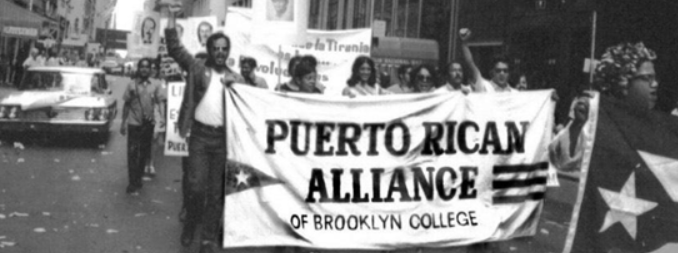
When the Puerto Rican Studies Department, the forerunner of PRLS, was founded in the early 1970s, fewer than 1% of the students at Brooklyn College were Puerto Rican. Despite having thousands of Latino students today, the department has less funding and fewer resources than some directors of the department had several decades previously.
By 2007 the Center for Puerto Rican Studies, CENTRO, at Hunter College reported that Puerto Rican Studies programs at CUNY were consistently “diminished… primarily for budgetary reasons” whenever those programs were placed under the purview of other ethnic studies departments.
Students say these pressures continue today and are part of a larger pattern of reducing humanities classes. During the COVID-era budget cuts, CUNY eliminated over 3,000 adjunct class sections, disproportionately affecting humanities programs.
“This is about what stories get told, and which ones get erased,” said Dr. Yarimar Bonilla, director of CENTRO, during a 2023 public panel on austerity and Puerto Rican cultural institutions. “Ethnic studies programs are structurally underfunded because they challenge the status quo. That is not accidental.”
Bonilla has also warned that austerity measures typically accompany periods of political mobilization for marginalized people.
“In times of crisis, policing, colonialism, Palestine, there is always pressure to shrink the spaces where critical conversations happen.”
In 2024, CUNY received a $5 million grant from the Andrew W. Mellon Foundation to continue and expand the Black, Race, and Ethnic Studies Initiative (BRESI), allowing Brooklyn College, among other schools, to offer new courses, support academic research, and offer internships. But experts say BRESI cannot reverse decades of erosion.
“This is patchwork,” an ethnic studies researcher said during a public BRESI briefing in 2022. “Useful, but not a substitute for rebuilding what decades of cuts eroded.”
Some PRLS students have noted a relationship between CUNY’s funding priorities and the wider national atmosphere on Palestine activism. After pro-Palestine demonstrations on campuses nationwide, administrators faced pressure from donors, elected officials, and the media to more rigorously scrutinize curriculum and activism taking place in ethnic studies environments. Some students argue that austerity leaves PRLS especially vulnerable to these pressures.
Some PRLS students say the climate at CUNY has shifted further in the past year, shaped by national backlash to pro-Palestine demonstrations and new campus disciplinary practices. Students at multiple CUNY campuses reported receiving misconduct charges related to protest actions, including charges for “failures to comply,” “disruptive conduct,” and “unauthorized demonstration.” Brooklyn College’s Undergraduate Student Government and administration did not respond to repeated requests for comment.
Puerto Rican Alliance’s (PRA) president Angelina Rivera neologized the political climate surrounding ethnic studies as “the broader political environment exacerbated by campus protests,” referencing the campus conduct charges against students across CUNY related to the protests from the previous spring. She told the audience at the Encuentro event that “Our biggest issue as a club now is repression from the administration, especially against political activism,” in reference to the focus on PRLS and solidarity organizing.
“Even now, there are a lot of students facing conduct charges we’re still worrying about,” Rivera added.
While PRLS fights for stability, other departments are growing. Jewish Studies programs across CUNY have received millions in philanthropic donations, including a $3 million donation to CUNY Queens College’s Jewish Studies program in 2023.
Meanwhile, STEM programs receive more consistent investment: CUNY received $18 million in National Science Foundation STEM grants in 2023-2024. Brooklyn College’s new science facilities were funded through state capital allocations exceeding $100 million over the past decade.
“STEM expansion is funded as the future,” Bonilla noted in the 2022 panel. “But communities also need the tools to understand power, race, and history. When those programs shrink, students lose more than classes, they lose the language to understand their world.”